| Factor
Payments from Abroad. Definition |
Róbinson Rojas
Net Factor Payments from Abroad.
All economies. 1960 to 1992 |
From United Nations WESP 2009:
Financing for
development
Amidst the unfolding global financial crisis, developing countries
continued to make increasing substantial net outward transfers of
financial resources to developed countries, reaching an all-time high
of $933 billion in 2008 (see figure III.1 and table III.1). After a
moderation in the rate of increase in 2007, outward transfers increased
more rapidly again in 2008. Net financial transfers are defined as net
financial inflows less net factor and investment income payments to
abroad which have become increasingly negative, implying resource flow
out of developing economies. This trend has been continuing for over a
decade.
Net resource flows from poor to rich countries
Private capital flows to developing countries
Foreign direct investment
International financial cooperation
Rehabilitating the global financial system
Governance reform at the Bretton Woods institutions
|
From the Federal Reserve Bank of Kansas City
- 2006
Going Global: the changing
pattern of U.S. investment abroad
By Marcella Mireille Aurélio
|
The New Economic Geography: effects and policy
implications
A symposium
sponsored by The Federal Reserve Bank of Kansas City
August 24-26, 2006
- Shift in
economic geography and their causes
- Consequences for production and prices, employment and wages
- Consequences for financial markets and global savings and investment
- Strategies for growth - Implications for monetary policy - Overview
panel
-----------------------
From The Economist
On the hiking trail
Globalisation
is generating huge economic gains. That is no reason to ignore its costs
Aug 31st 2006
----------------------- |
| Link to Integrated International
Production |
| Link to
"The Triad: European Union, U.S.A. and Japan)" |
| Global Development
Finance 2004 |
| Global Development
Finance 2003 |
| Global Development
Finance 2002 |
State Administration of Taxation - 2002
People's Republic of China
Transfer Pricing Tax System and the
development in China
"Statistics show that between 1988 and 1993, 35-40% of FIEs reported
losses. Between 1994 and
1995, 50-60% reported loss. Between 1996 and 2000, 60-70% reported
losses. It was true that
some FIEs did lose money. Most others however were fake losers. They
were avoiding tax by
using schemes such as TP."
http://www.asiatoday.com.au/feature_reports.php?id=264
|
The interactions between China and the world
economy
by Yu Yongding ( 2005), Director Institute of World Economics and
Politics
Chinese Academy of Social Sciences
In 2003, the Chinese economy started to pick up strongly. For two
consecutive years since then, China’s growth rate surpassed 9%, while
inflation was under 5% cent and droping. China’s high growth
contributed greatly to the global growth over the past two years. At
the same time, the “China factor” has caused or worsened the shortage
of some energy and raw materials, and drived many prices of energy and
raw materials sky high. Faced with the rise of China, many people are
worried about not only its current but also its long-run impact on the
world economy. In this presentation, I will argue that China will be
able to maintain a high growth rate for decades to go and China’s
impact on the world economy will be sizable. But the impact should not
be exaggurated. China’s current sharp increase in the demand for energy
and minirial resources, to a large extent, is cyclica and will be
tapering off fairly soon. China is fully aware of its international
responsibility as a rising coountry. China will continue to enbrace
globalization and abide by all international rules and norms. China
will continue to make efforts to maintain and improve the international
order, and actively participate in regional economic and financial
cooperation.
|
Olena Havrylchyk, CEPII,
Sandra Poncet, CES (University Paris 1, Panthéon-Sorbonne) and CEPII
2004
Foreign Direct Investment in China: Reward or
Remedy?
In his book “Selling China” Huang (2003) states that a high level of
foreign direct investment (FDI) in China is not necessarily a sign of
strength, but can be partly attributed to the distortive nature of
state policies that put restrictions on private and public enterprises.
First of all, the Chinese financial system allocates resources to the
least efficient firms – state-owned enterprises – while denying the
same resources to Chinese private enterprises, forcing them to look for
a foreign investor. Second, the inefficient system of state investment
planning leads to mismanagement of public enterprises, increasing
“insolvency induced FDI”. We propose to analyze determinants of FDI in
Chinese provinces to test the above hypotheses. We control for
traditional determinants of FDI such as market access, labor costs,
productivity, infrastructure, reform advances and banking sector size
in order to assess the impact of inter-provincial heterogeneity in
terms of the access that private enterprises have to credit and the
distortive management in state-owned firms.
|
Institute of World Economics and Politics
Chinese Academy of Social Sciences
China's road to prosperity
By Yu Yongding, 2004-8-27
Over the past two decades, China’s economy has registered an annual
average growth rate of more than 9 percent. Now few foreign observers
still have serious doubt about China’s economic achievement. However, a
fundamental question remains unsolved. That is, will China’s economic
growth sustainable? Will there be any major interruptions arise in
China’s growth process. Some Chinese economists are even asking the
question of whether China will eventually be Latin -Americanized? My
view of China’s economic prosperity is one of cautiously optimistic.
However, I would also like to emphaze that China’s road for modernation
will be rather bumpy. If the Chinese government fails to solve many
political, social and economic problems, China’s endeavor for
modernization still may suffer important setback.
|
Chen Chunlai, 1997
Provincial characteristics and
foreign direct investment location decision within China
Foreign direct investment (FDI) is one of the most dramatic features of
China’s move
from a planned economy toward a market economy. Since the passing in
late 1979 of
the Equity Joint Venture Law which granted legal status to FDI in
Chinese territory,
China has gradually liberalised its FDI regime, and an institutional
framework has
been developed to regulate and facilitate such investments. The
liberalisation of the
FDI regime and the improved investment environment have greatly
increased the
confidence of foreign investors in China. Consequently, FDI inflows
into China
increased rapidly after 1979, and particularly during the early 1990s.
The total
accumulated amount of FDI at current prices rose from the initial
US$0.109 billion in
1979 to reach US$133.19 billion in 1995, at an annual growth rate of
55.93 percent...
|
Chen Chunlai, 1997
The location determinant of
Foreign Direct Investment in developing countries
Since the late 1980s and especially in the early 1990s, China has
received a huge
amount of FDI in absolute terms. Its share both in the world total FDI
inflows and in the
total FDI inflows into developing countries has increased rapidly. As a
result, since
1992 China has been the single largest host country among all
developing countries, and
further since 1993 China has become the second largest FDI recipient in
the world
(following the United States). China’s success in attracting FDI into
its domestic
economy in recent years has caused concern in many other developing
countries that the
huge amount of FDI inflows into China may represent a diversion of
world FDI away
from them.
However, China is large, and large countries normally receive a large
amount of
FDI inflows. Has China really received more FDI inflows from the world
than it should
have, based on its economic and geographical characteristics? To answer
this question
we have to investigate the location determinants affecting FDI inflows
into developing
countries and establish an empirical norm of the magnitude of aggregate
FDI inflows...
|
Chen Chunlai, 1997
Comparison of investment
behaviour of source countries in China
Since China launched the economic reforms and called for direct foreign
capital
participation in boosting its economic growth and upgrading its overall
production
technology, China has become one of the world most important countries
to host
foreign direct investment (FDI). On the one hand, FDI inflows into
China increased
rapidly after 1979, and particularly during the early 1990s. On the
other hand, more
than 100 countries have invested in China. As a result, since 1993
China has become
the second largest FDI recipient in the world (following the United
States) and the
single largest host country among the developing countries (United
Nations, 1995, p.
54). However, what is the composition of the source countries of FDI in
China? Do
the source countries differ in their investment behaviour? This paper
will discuss and
answer these questions...
|
UNCTAD
Development and
Globalization: Facts and Figures 2004
Analyses supported by
detailed statistical documentation. The report is aimed at a broad
audience, including readers with little or no background in economics.
It provides an overview of the evolution of developing countries in the
context of globalization. It is a quick-reference tool for evaluating
the growth prospects of developing countries. General topics covered
include population and economic trends, external finance and debt,
foreign direct investment, transnational corporations, international
trade, production and trade of commodities and manufactures, and
information and communication technologies (ICT). 119 pages. |
UNCTAD
Foreign Direct
Investment Statistics
|
From UNCTAD - October 2006
Need for more policy autonomy
10 October 2006 - At the final meeting of UNCTAD´s Mid-Term Review,
developing countries called for more room for policy manoeuvre and a
strengthening of the Aid for Trade initiative. Participants also said
the trade negotiations should be more development focused. UNCTAD´s
Mid-Term Review concluded today with member States agreeing that
developing countries, in fashioning the individualized plans that will
best enable them to expand their economies, have the right to strike a
balance between development goals and the rules and commitments
contained in international trade and financial agreements.
|
|
|
Booming
South-South investment creates development opportunities, says UNCTAD
UNCTAD/PRESS/PR/2006/027 - , 16/10/06
Also available in: French
Spanish
|
Firms
based in developing countries joining ranks of world's largest
transnational corporations
, UNCTAD/PRESS/PR/2006/034 - , 16/10/06
Also available in: French
Spanish
|
Gravity
shifts to Asia in global FDI and R&D networks
, UNCTAD/PRESS/PR/2005/053 - , 15/11/05 |
Foreign
direct investments rebounds in Latin America & The Caribbean
, UNCTAD/PRESS/PR/2005/037 - , 29/09/05
Also available in: French
Spanish
|
Foreign
direct investment in Africa remains buoyant, sustained by interest in
natural rseources
, UNCTAD/PRESS/PR/2005/035 - , 29/09/05
Also available in: French
Spanish
|
FDI
rises for fourth year in a row in South-East Europe, Commonwealth of
Independent States
, UNCTAD/PRESS/PR/2005/038 - , 29/09/05
Also available in: French
Spanish
|
New
UNCTAD surveys: Foreign Direct Investment prospects promision for
2005-2008
, UNCTAD/PRESS/PR/2005/031 - , 05/09/05
Also available in: Spanish
|
Transnational
corporations expected to increase dominance of clothing and textile
sectors, says UNCTAD
, UNCTAD/PRESS/PR/2005/019 - , 13/06/05
Also available in: French
Spanish
|
Firms
in developing countries rapidly expanding foreign investment,
transnational activities
, UNCTAD/PRESS/PR/2005/018 - , 30/05/05
Also available in: French
Spanish
|
A
decade of FDI liberalization: the evidence
, UNCTAD/PRESS/IN/2005/012 - , 16/03/05
Also available in: French
|
China
is not crowding out FDI from the rest of East Asia, experts say
, UNCTAD/PRESS/IN/2005/007 - , 07/03/05
Also available in: French
Spanish
|
New
role for Japan's Sogo Shosha as they shift from manufacturing to
services
, UNCTAD/PRESS/IN/2005/002 - , 20/01/05
Also available in: French
|
New
Issue of Transnational Corporations Journal published
, UNCTAD/PRESS/IN/2005/001 - , 14/01/05
Also available in: French
|
World
FDI flows grew an estimated 6% in 2004, ending downturn
, UNCTAD/PRESS/PR/2005/002 - , 11/01/05
Also available in: French
|
Towards
centre stage: trade gains for the South can mean progress on Millenium
Development Goals
, UNCTAD/PRESS/PR/2004/041/Corr.1 - , 20/12/04
Also available in: French
Spanish
|
Africa:
turnaround in FDI inflows last year
, UNCTAD/PRESS/PR/2004/024 - , 22/09/04
Also available in: French
Spanish
|
Foreign
Direct Investment: a rebound in the offing, led by FDI in developing
countries and FDI in services
, UNCTAD/PRESS/PR/2004/022 - , 22/09/04
Also available in: French
Spanish
|
FDI
inflows to Latin America and the Caribbean: another disappointing yera
, UNCTAD/PRESS/PR/2004/026 - , 22/09/04
Also available in: French
Spanish
|
FDI
down in three Latin American economies
, UNCTAD/PRESS/EB/2004/007 - , 05/03/04
Also available in: French
|
Many
African countries see declining FDI in 2002
, UNCTAD/PRESS/EB/2004/002 - , 20/01/04
Also available in: French
Spanish
|
FDI
plunges in Argentina, Venezuela
, UNCTAD/PRESS/EB/2003/09 - , 12/12/03
Also available in: French
Spanish
|
FDI to
Latin America and the Caribbean plummeted in 2002
, UNCTAD/PRESS/PR/2003/91 - , 04/09/03
Also available in: French
Spanish
|
Africa
not spared by global downturn in Foreign Direct Investment
, UNCTAD/PRESS/PR/2003/87 - , 04/09/03
Also available in: French
Spanish
|
FDI
flows to Italy climb, bucking downward global trend
, TAD/INF/B35/E - , 24/05/03
Also available in: French
Spanish
|
 |
UNCTAD predicts 27% drop in FDI inflows this year,
TAD/INF/PR/63 - , 24/10/02
Also available in: French
Category: Press information
2002
|
|
Dynamic products make for dynamic economies,
TAD/INF/PR/61 - , 01/10/02
Also available in: French
Spanish
Category: Press information
2002
|
|
US remains world's largest
recipient of foreign direct investment, TAD/INF/PR/58 - , 17/09/02
Category: Press information
2002
|
|
Government and business
leaders meet to increase investment in Africa, TAD/INF/PR/39 - ,
20/03/02
Category: Press information
2002
|
|
FDI downturn in 2001
touches almost all regions, TAD/INF/PR/36 - , 21/01/02
Category: Press information
2002
|
|
Latin America's inflows
down in 2000, TAD/INF/PR/28 - , 18/09/01
Also available in: Spanish
Category: Press information
2001
|
|
Meeting the competitive
challenge: linking TNCs with local suppliers, TAD/INF/PR/22 - ,
18/09/01
Also available in: French
Spanish
Category: Press information
2001
|
|
Developed country FDI
soars by 21%, TAD/INF/PR/27 - , 18/09/01
Also available in: French
Spanish
Category: Press information
2001
|
|
FDI increases to the
World's poorest countries, LDCIII/PRESS/01 - , 10/05/01
Category: Press information
2001
|
|
Partnerships for
development: how can private sector enhance LDC's productive capacity?,
TAD/INF/PR/01 - , 26/01/01
Also available in: French
Category: Press information
2001
|
|
FDI to Africa rises in
1999, but continent must become bigger market player, says UNCTAD report,
TAD/INF/PR/057 - , 03/10/00
Also available in: French
Category: Press information
2000
|
|
Prospects brighten for
foreign investment in Asia, TAD/INF/PR/058 - , 03/10/00
Also available in: French
Category: Press information
2000
|
|
Survival in global
business arena is key driver of cross-border merger and acquisition boom,
TAD/INF/PR/055 - , 03/10/00
Also available in: French
Spanish
Category: Press information
2000
|
|
FDI in Latin America hits
record levels, fuelled by long-term growth prospects, privatizations,
TAD/INF/PR/060 - , 03/10/00
Category: Press information
2000
|
|
World’s largest
transnational corporations cautiously optimistic about Africa's
potential for attracting foreign direct investment, TAD/INF/PR/039
- , 15/02/00
Also available in: French
Category: Press information
2000
|
|
Foreign investment gains
in Latin America. Brazil inflows rise sharply to record,
TAD/INF/PR/9924 - , 23/09/99
Also available in: Spanish
Category: Press information
1999
|
|
Developed countries boost
foreign direct investment by 46 per cent to new record,
TAD/INF/PR/9926 - , 23/09/99
Also available in: French
Spanish
Category: Press information
1999
|
|
Foreign Investment Flows
into Central and Eastern European Countries Make Major Gains. Latvian
Shipping Co. Leads New List of the Top 25 Transnational Corporations in
Central Europe, TAD/INF/PR/9925 - , 23/09/99
Also available in: French
Category: Press information
1999
|
|
International production
drives globalization, TAD/INF/PR/9920 - , 07/09/99
Also available in: French
Spanish
Category: Press information
1999
|
|
Foreign Direct Investment by Transnational
Corporations can produce major benefits, if the right government
policies are in place, TAD/INF/PR/9919 - , 03/09/99
Also available in: French
Spanish
Category: Press information
1999
|
|
Foreign Direct Investment
into developing Asia has weathered the storm, TAD/INF/PR/9903 - ,
27/04/99
Also available in: French
Category: Press information
1999
|
|
Educating policymakers on
international investment issues, TAD/INF/PR/99008 - , 18/02/99
Also available in: French
Category: Press information
1999
|
|
Business works with UNCTAD
to boost investment in Africa, TAD/INF/PR/99004 - , 19/01/99
Also available in: French
Category: Press information
1999
|
|
Foreign Direct Investment
to Central and Eastern Europe Rises to US$19 billion in 1997,
TAD/INF/PR/9842 - , 02/11/98
Also available in: French
Category: Press information
1998
|
|
Encouraging signs for
Foreign Direct Investment into Africa, TAD/INF/PR/9844 - , 02/11/98
Also available in: French
Category: Press information
1998
|
|
Foreign Direct Investment
on the rise, TAD/INF/PR/9824 - , 02/09/98
Also available in: French
Category: Press information
1998
|
|
World Investment Report
1997: FDI and competition policy, TAD/INF/PR/9715 - , 09/09/97
Also available in: French
Category: Press information
1997
|
|
Business globalization
continues to boom, TAD/INF/PR/9714 - , 09/09/97
Also available in: French
Category: Press information
1997
|
|
Continued upswing of
global FDI in 1996, TAD/INF/PR9711 - , 10/07/97
Also available in: French
Category: Press information
1997
|
|
Oil eclipsed? The rise of
manufacturing and services FDI in West Asia, TAD/INF/PR/9707 - ,
27/05/97
Also available in: French
Category: Press information
1997
|
|
Transnational
Corporations: New Issue Released, TAD/INF/NC/96_39 - , 28/11/96
Category: Press information
1996
|
|
Need for a holistic
approach to Foreign Direct Investment, TAD/INF/PR/9629 - , 11/10/96
Category: Press information
1996
|
|
Investment policies
examined in a new issue of "Transnational Corporations" released today,
TAD/INF/NC/96_22 - , 09/10/96
Category: Press information
1996
|
|
UNCTAD convenes a global
investment forum, TAD/INF/PR/9625 - , 03/10/96
Category: Press information
1996
|
|
Report outlines ways to
boost lagging European Union direct investment in Asia,
TAD/INF/PR/9608 - , 19/03/96
Also available in: French
Category: Press information
1996
|
|
JETRO's annual surveys
JETRO
publishes an annual White Paper on International Trade and Foreign
Direct Investment (FDI). The paper includes JETRO's estimates for world
trade and FDI figures, as well as in-depth analysis of the world
economy?and Japan's place in it. Previous white papers have focused on
such issues as intellectual property rights, the impact of FTAs,
overseas operations of Japanese firms as well as the state of foreign
direct investment in Japan. The paper is first published in Japanese
and later translated into English.
|
WORLD
INVESTMENT REPORT 2010
Investing in a low-carbon economy
There are some major changes in global
FDI patterns that preceded the global crisis
and that will most likely gain momentum
in the short and medium term. Firstly, the
relative weight of developing and transition
economies as both destinations and sources
of global FDI is expected to keep increasing.
These economies, which absorbed almost
half of FDI inflows in 2009, are leading the
FDI recovery. Secondly, the recent further
decline in manufacturing FDI, relative to
that in the services and primary sectors, is
unlikely to be reversed. Thirdly, in spite
of its serious impact on FDI, the crisis has
not halted the growing internationalization
of production.
This year’s Report focuses on climate change, and in particular the
role of transnational
corporations. As enterprises with formidable knowledge, cutting-edge
technology, and
global reach, TNCs are necessarily among the primary actors in the
global effort to reduce
greenhouse gas emissions and shift towards a low-carbon economy. The
Report stresses
that with the right policy initiatives, incentives and regulatory
framework, TNCs can and
must contribute significantly to both mitigation and adaptation. It
also proposes a global
partnership to galvanize low-carbon investment and advocates concrete
initiatives such
as a new technical assistance centre to support policy formulation and
implementation in
developing countries.
|
WORLD INVESTMENT REPORT 2009
Transnational Corporations, Agricultural Production and Development
The Report covers, in particular, questions such as:
- What are the differences between individual
regions in terms of their responses in FDI flows to the crisis? Why did
the crisis affect FDI to developing countries later than developed
countries?
- What are the prospects for FDI in 2009 as well as
for the medium term?
- How has the crisis affected national and
international policies related to FDI? Has the path of more
liberalizations been continued or reversed?
- In the midst of a major industrial restructuring,
which companies are the winners and losers in the universe of the
world´s largest TNCs?
- Why is agriculture such a special industry for
developing countries - and what are its longer term prospects? What
role can TNCs play in improving the productivity of agriculture in
developing economies?
- How robust is the renewed interest by TNCs in
agriculture? Who are the new investors and how do they differ from
traditional TNCs? What are the pros and cons of developing country
farmers being drawn into global agribusiness value chains?
- What can developing countries expect from the
renewal of FDI in agriculture? Given the past record, will this time
the impact of TNCs in agriculture be different?
- How does TNC participation in agricuture affect
socially sensitive issues, including those related to food security and
the food crisis; as well as the non-food uses of agricultural produce
for biofuels?
- What policy challenges does TNC involvement in
agriculture raise? How are they being addressed within the framework
national economic strategies, with the aim of maximizing benefits and
minimizing costs from TNC involvement?
- Are policy makers sufficiently prepared to meet
the challenges? How can the international community support them?
According to WIR09, after decades of slow growth, TNCs´
interest and participation in agriculture - including FDI - is again on
the rise. Despite this rise, in most countries today only a small share
of FDI goes to agriculture. There are nevertheless some developing
countries, including least developed countries (LDCs), where the share
of agriculture in inward FDI is relatively important. Renewed interest
of foreign investors in agricultural investment is significant enough
to raise questions about whether FDI and other forms of TNC
participation in agriculture can contribute to the development of this
long neglected industry. WIR09 suggests an integrated policy approach
that takes into account all concerns arising from TNC involvement.
|
WORLD INVESTMENT REPORT 2008
Transnational corporations and the infrastructure challenge
Host countries need to consider when it is
appropriate to draw TNCs into the development and
management of infrastructure. They also need to find
ways of ensuring that projects with TNC involvement
lead to the expected development effects. This is a
complex policy challenge.
As policy priorities and options vary between
countries, so too does the optimal mix of public
and private (including TNC) investment. Designing
and implementing appropriate policies to harness
the potential role of TNCs in infrastructure require
adequate skills and capabilities. Governments need
to prioritize among competing demands for different
projects, establish clear and realistic objectives for
the projects chosen, and integrate them into broader
development strategies. This means that government
agencies have to possess the necessary institutional
capacity and skills to guide, negotiate, regulate and
monitor the projects. This applies not only at the
central level, but also in provincial and municipal
governments.
While many developing countries seek foreign
investment to develop their physical infrastructure,
convincing foreign companies to invest has in many
cases become even more challenging.
|
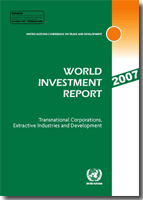
WORLD INVESTMENT REPORT 2007
Transnational
Corporations, Extractive Industries and development
World
Investment Report 2007 (WIR07) is the seventeenth in a
series published by the United Nations Conference on Trade and
Development (UNCTAD). The Report analyses the latest
trends in foreign direct investment (FDI) and puts a special focus in
2007 on the role of transnational corporations (TNCs) in the extraction
of oil, gas, and metal minerals.
Higher
prices for many minerals have led to renewed investor interest in the
extractive industries. TNCs ( including some of the world´s
largest corporations) play a key role in the mining of metals and in
the extraction of oil and gas. Privately owned TNCs dominate the
harvesting of metal minerals, while State-owned companies from
developing and transition economies are key players in oil and gas.
Many such State-owned firms are emerging as TNCs in their own right.
Drawing
on unique data, the Report examines TNC involvement
in the extraction of mineral resources and maps the key countries and
companies. It also discusses how the forces driving investment change
as raw materials progress up the "value chain" to become finished
products, and as different types of companies participate. In view of
recent discussion of the so-called "resource curse," the Report
explores how the participation of TNCs may help or
hinder long-term, broad-based economic development in developing
countries -- the best approach for reducing poverty and raising living
standards. It considers how energy and mineral extraction can help
governments achieve such aims.
In
addition to the general information on definitions and sources provided
in this year´s World Investment Report, more detailed
methodological notes for the data on FDI flows and stocks used in the
Report - including how they were obtained for each economy - are
available in electronic format only.
|
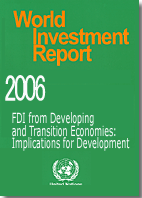 WORLD INVESTMENT REPORT 2006 WORLD INVESTMENT REPORT 2006
FDI from Developing and Transition Economies: Implications for
Development
This year´s World Investment Report focuses on the
rise of foreign direct investment (FDI) by transnational corporations
(TNCs) from developing and transition economies.
New sources of FDI are emerging among developing and transition
economies. This phenomenon has been particularly marked in the past ten
years, and a growing number of TNCs from these economies are emerging
as major regional - or sometimes even global - players. The new links
these TNCs are forging with the rest of the world will have
far-reaching repercussions in shaping the global economic landscape of
the coming decades.
The Report examines the magnitude of this phenomenon and examines its
drivers and determinants, i.e.: what economic factors and policy
developments lead firms from developing countries to venture abroad?
For low-income countries, FDI from developing countries can be of great
importance. In some of them, it accounts for a significant share of all
FDI flows. The Report also discusses the development implications of
the rise of these new sources of FDI, along with policy responses, for
both home and host developing countries.
As in previous years, the Report also presents the latest data on FDI
and traces the global and regional trends of FDI and international
production by TNCs. Global FDI inflows rose substantially in 2005. A
major contributing factor to this strong growth was the marked increase
in the inflows to developed countries. Rising global demand for
commodities was reflected in the steep increase in natural
resource-related FDI, although the services sector continued to be the
major recipient of FDI. Among developing regions, Asia remained the
main magnet for FDI flows, followed by Latin America, where re-invested
earnings have played a major role. Africa´s share in world FDI inflows
was still small, but its FDI growth rate has nonetheless surpassed
those of other developing regions.
A substantial Statistical Annex is also included,
with data on FDI flows and stock for more than 200 economies. The PDF
version of WIR05 and the Statistical Annex are available in a CD-ROM.
METHODOLOGICAL NOTES: Definitions and Sources. In addition to the
general information on definitions and sources provided in this year´s World
Investment Report, more detailed methodological notes for the data
on FDI flows and stocks used in the Report - including how they were
obtained for each economy - are available in electronic format only.
|
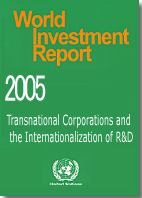 WORLD INVESTMENT REPORT 2005 WORLD INVESTMENT REPORT 2005
Transnational Corporations and the Internationalization of R&D
World
Investment Report 2005 (WIR05) presents the latest trends in
foreign direct investment (FDI) and explores the internationalization
of research and development by transnational corporations (TNCs) along
with the development implications of this phenomenon.
Part One highlights recent global and
regional trends in FDI and international production by TNCs. Global FDI
flows resumed growth in 2004, but inflows continued to decline in
developed countries. This Part documents the fact that developing
regions are leading the recovery in FDI flows. It also documents
different trends and patterns between developed and developing
countries as regards the financing component of FDI (equity investment,
reinvested earnings, intra-company loans) as well as the modes of
investment (mergers and acquisitions, greenfield FDI).
Part Two assesses the implications of the
recent surge in R&D internationalization by TNCs. R&D
activities at growing levels of complexity are increasingly being
established in selected developing countries. In contrast to past
experience, this R&D often goes beyond local market adaptation and
involves highly complex activities targeted on global markets. The
Report discusses the driving forces behind this trend and considers how
host as well as home countries are affected. Finally, the Report
analyses the need for active government policies to enhance development
benefits from TNCs´ internationalization of R&D. The Report
underlines the importance of coherent policies in order to create an
environment conducive to fruitful interaction between the R&D
activities of TNCs and those of domestic firms and institutions. A
final chapter outlines the role of international agreements in this
area.
A substantial Statistical Annex is also included,
with data on FDI flows and stock for more than 200 economies. The PDF
version of WIR05 and the Statistical Annex are available in a CD-ROM.
METHODOLOGICAL NOTES: Definitions and Sources
In addition to the general information on definitions and sources
provided in this year´s World Investment Report, more
detailed methodological notes for the data on FDI flows and stocks used
in the Report - including how they were obtained for each economy - are
available in electronic format only.
|
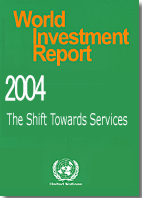 WORLD INVESTMENT REPORT 2004 WORLD INVESTMENT REPORT 2004
The Shift Towards Services
WIR04 presents the latest trends in foreign direct
investment and explores the shift towards services, with a special
analysis of offshoring service activities.
Part One discusses recent global and regional
trends in FDI and international production by TNCs. Global FDI flows
bottomed out in 2003, but there were some regional differences. The
sectoral pattern of FDI is shifting towards services. Outward FDI from
developing countries is becoming significant. There is also optimism
that inflows to these countries will increase in 2004 and beyond.
Part Two deals with FDI in services - an important
but often neglected area of FDI in the context of development. It
examines the shift of FDI towards services with a focus on the entry of
TNCs into new service areas. Services FDI, especially in intermediate
and infrastructure services, affects the economic performance of a
host-country in all sectors. The offshoring of corporate services is
taking off rapidly, thanks to advances in information and
communications technologies. However, the potential of such offshoring
can only be harnessed if countries adopt appropriate policies.
Part Three analyses key issues relating to
national and international policies on FDI in services. As many
services are deeply embedded in the social, cultural and political
fabric of host societies, the impact of FDI on those services could be
far-reaching. Therefore, national policies matter - not only to attract
FDI in services, but also to maximize its benefits and minimize its
potential negative impacts. The proliferation of international
investment agreements (IIAs) covering FDI in services has resulted in a
multifaceted and multilayered network of international rules that
affect national policy-making.
The WIR04 includes a substantial statistical annex, which is
also available on CD-ROM.
Quick Links: | World
Investment Directory Online |
|
WORLD INVESTMENT REPORT 2003
FDI Policies for Development: National and International Perspectives
The World Investment Report 2003 focuses on the foreign direct
investment (FDI) downturn, its reasons and the role of national
policies and international investment agreements (IIA) in attracting
FDI to a country and for a country to benefit from it.
Part One discusses the overall trends in FDI. FDI flows have dropped
drastically and no rebound is expected in 2003. The reasons for the
downturn are discussed from a global perspective, as well as by region
- developed countries, Africa, Asia and the Pacific, Latin America and
the Caribbean, and Central and Eastern Europe.
Part Two focuses on key issues that straddle national FDI policies and
international investment agreements with a view to bringing out the
development dimension. Special attention is given to the rise of IIAs,
the right to regulate, home country measures and corporate social
responsibility.
The report includes a statistical annex of over 100 pages.
Quick Links: | Press
Conference Opening Statements |
|
 WORLD INVESTMENT REPORT 2002 WORLD INVESTMENT REPORT 2002
Transnational Corporations and Export Competitiveness
The first principal finding is that foreign direct investment (FDI)
inflows in 2001 declined to $735 billion. This is less than half the
2000 figure. Behind this decline is the slowdown in the world economy
and a weakening of business confidence, both of which were accentuated
by the September 11 events in the United States, and both of which
contributed to a sharp reduction of cross border mergers and
acquisitions that take place predominantly between industrialized
countries. In light of the prolonged economic recession and the slow
recovery of business confidence, especially in the United States,
UNCTAD does not expect a rebound of FDI flows this year. Despite the
decline in FDI flows, the expansion of international production
continues, although at a slower pace. However, developments differ
markedly between various parts of the world. The FDI downturn was
concentrated in the developed countries (-59%), with only modest
declines in flows to developing countries (-14%) and even a small
increase in flows to Central and Eastern Europe (2%). There were also
significant variations within the third world, with lower levels of
inflows to Asia and Latin America but an increase to Africa. Africa,
however, still remains a marginal recipient of FDI.
|
WORLD INVESTMENT REPORT 2001
Promoting linkages
The World Investment Report 2001 examines the issue of linkages between
foreign affiliates of multinational enterprises and local companies in
developing countries. Worldwide FDI flows again reached record levels
in 2000. FDI remains the main driver of the expansion of the
international production system. Forging linkages between foreign
affiliates and domestic firms is a main challenge for policy-makers in
developing countries in order to benefit from FDI as much as possible.
WIR 2001 pays particular attention to this challenge. The objective is
not to raise linkages at any cost, but to use them to upgrade the
competitive capabilities of domestic enterprises. Fostering linkages is
an important means of diffusing knowledge, information and skills from
a foreign investor. In a technology and skill driven world, this can
contribute to increasing the efficiency and growth potential of the
host economy. WIR 2001 provides valuable information on country and
company experience in this field.
|
WORLD INVESTMENT REPORT 2000
Cross-border Mergers and Acquisitions and Development
The contribution of foreign direct investment to development is now
widely recognized.
There is a perception, however, that this contribution may be affected
by the way investment enters a country. It may come in the form of a
new enterprise or the expansion of an existing enterprise; it may also
come through a merger or an acquisition. Acquisitions, in particular,
arouse concerns, especially over employment, ownership and market
structure. And the concerns become urgent when the host economy is a
developing one.
Given the recent explosion in cross-border mergers and acquisitions,
UNCTAD´s 10th World Investment Report is a highly timely and important
document. This phenomenon calls for just the sort of careful and
dispassionate analysis that has become the hallmark of the WIRs.
Cross-border mergers and acquisitions are a part of economic life in a
liberalizing and globalizing world. But accepting a more open market in
the interests of growth and development does not mean relaxing the
requirements of public vigilance. On the contrary, a freer market - and
particularly the emerging global market for enterprises - calls for
greater vigilance as well as stronger and better governance. To this
end, World Investment Report 2000 provides us with a valuable resource.
Kofi A. Annan
Secretary-General of the United Nations
|
 WORLD INVESTMENT REPORT 1999 WORLD INVESTMENT REPORT 1999
Foreign Direct Investment and the Challenge of Development
WIR 99 is the ninth Report in an annual series that has been recognized
as the most up-to-date and comprehensive source of information as well
as analysis regarding foreign direct investment (FDI).
Part I, entitled Trends,examines the most recent global and regional
trends in FDI. It describes the world´s 100 largest TNCs, the 50
largest TNCs in developing countries and the 25 largest TNCs in Central
Europe; analyses the momentum for an increasing globalization of
economies through FDI and the activities of TNCs; and explores the
growing importance of mergers and acquisitions in fuelling FDI flows.
It also reviews recent developments in bilateral and regional
investment agreements including the reasons for the end of negotiations
of the Multilateral Agreement on Investment.
Part II, entitled FDI and the Challenge of Development, looks at the
impact of FDI on key objectives of economic development: increasing
financial resources for investment, enhancing technological
capabilities, boosting export competitiveness, generating and upgrading
employment, and protecting the environment.
The Report concludes that although FDI can yield major economic
benefits for the host country, such benefits can be enhanced through
appropriate policies. Governments therefore have an important role to
play in creating the conditions that attract FDI and in maximizing the
positive contribution that FDI can make to growth and development.
|
1998 - Trends and Determinants
|
WORLD INVESTMENT REPORT 1997
Transnational corporations, market structure and competition policy
Improving economic
efficiency by making markets more competitive -- and thereby
serving development -- is subject to the same need to make choices.
Given the particular
characteristics of developing countries -- low income levels, skewed
distribution of wealth,
lack of infrastructure, low levels of education, asymmetries in
information, to mention a few -
- the incidence of conflicts between market outcomes and competing
objectives is often more
frequent in these countries.
For example, where foreign exchange is temporarily in limited supply,
certain import
restrictions might be needed -- thus limiting contestability -- to
ensure that critical imports are
not disrupted, e.g.,
that foreign exchange reserves are used for machine parts instead of
luxury goods. Or, where a
country is characterized by dispersed rural communities, the market
will often not provide
these with certain basic services (such as roads, telecommunications
services and railways); in
these cases, governments might need to ensure that certain services
reach segments of the
national market which otherwise could not support such services. They
could do so, for instance,
by providing the services through state-owned enterprises or, where
private operators are
involved, by providing these with market power so that services in
less-economically viable
markets can be cross-subsidized from profits earned in larger segments
of the market.48 A
policy alternative to consider in such a case would be more direct
government involvement in
the form of subsidized provision of the services in question. The
decision in this case -- whether
to allow concentration combined with cross subsidization or to provide
subsidies -- would
involve a careful consideration of the quite different trade-offs
associated with these two options
(possibly less efficiency in the market, on the one hand, versus a
direct budgetary expense on
the other).
|
1996 - Investment, Trade and International Policy
Agreements
1995 - TNCs and Competitiveness
|
WORLD INVESTMENT REPORT 1994
Transnational corporations, employment and the workplace
The World Investment Report
1994 analyses the impact of an integrated international production
system on the quantity and quality of employment, human resource
development and, more generally, to the organization of work.
The report includes a statistical annex with FDI statistics and other
related indicators.
Policy makers and trade union leaders must find innovative ways to
respond to the ongoing changes in the international economy. Not only
must they address the many new issues raised by integration at the
level of production; but, in a more open and integrated world economy,
policy makers must coordinate more carefully the traditional
instruments for domestic economic management with policies relating to
international economic relations, including, in particular, foreign
direct investment (FDI) and other forms of TNC
activity.
|
 WORLD INVESTMENT REPORT 1993 WORLD INVESTMENT REPORT 1993
Transnational Corporations and Integrated International Production
The World Investment Report 1993 analyses the evolving strategies
and changing organizational structures of TNCs, and the implications of
the increasing functional, cross-national integration of their
activities for the location of international production. In spite
of an overall decline in world-wide flows of foreign direct investment
in the early 1990s, there are many features of the world economic
environment pointing to a continuing and important role for
transnational corporations.
The report includes a statistical annex with FDI statistics and other
related indicators.
|
 WORLD INVESTMENT REPORT 1992 WORLD INVESTMENT REPORT 1992
Transnational Corporations as Engines of Growth
The World
Investment Report 1992 analyses the relationship between TNCs and
economic growth. Since the early 1980s, world investment flows have
been expanding rapidly, much faster than other key economic variables
such as world trade and world output. A number of major new developments in the
global economic situation have placed foreign direct investment in a
central position to influence the pace and the nature of economic
growth in most countries. Finally, developing countries themselves have implemented
notable and, in many cases, dramatic policy changes, in order to open
their economies to greater contributions by transnational corporations.
The report includes a statistical annex with FDI statistics and other
related indicators.
|
 WORLD INVESTMENT REPORT 1991 WORLD INVESTMENT REPORT 1991
The Triad In Foreign Direct Investment
This first volume in the World Investment Report series analyses the
Triad (Japan, the European Community and the United States) in terms of
foreign direct investment.
It looks at the role transnational corporations play in
promoting regional economic integration around the three poles of the
Triad,
describes the linkages between foreign direct investment and
trade, technology and financial flows, and
highlights policy implications for developing countries and the
international community.
|
| |
|
| |
| |
| |
| |
Foreign Direct Investment in Africa:
Performance and Potential, 1999
Many African countries have already done much to create
a more business-friendly environment to promote local investment
as well as foreign direct investment, and many have made impressive
progress towards political and economic stability. In their efforts to
revive economic activity they have scaled down bureaucratic obstacles
and interventions in their economies, embarked on privatization
programmes and are putting in place pro-active investment measures.
These efforts -- helped by other factors such as high commodity prices
-- have borne fruit in recent years, leading to a turnaround after a
long period of economic contraction, in many countries. As a result,
for the first time since the early 1980s, per capita gross domestic
product
of the continent as a whole has grown considerably for a number of
consecutive years since 1994. Some countries that not so long ago
were being torn apart by civil unrest or war have recovered and are...
|
OECD - 1999
Southeast Asia: The role
of foreign direct investment policies in development
At a time of continuing financial crisis in Asia, the question of the
appropriate policies for
recovery and for future sustainable development is paramount. One area
of particular importance is the
treatment of foreign investors. Foreign direct investment (FDI) has
played a leading role in many of the
economies of the region, particularly in export sectors, and has been a
vital source of foreign capital during
the crisis. The four countries reviewed in this study1 — Indonesia,
Malaysia, the Philippines and Thailand
(referred to hereinafter as the ASEAN4) — have all to varying degrees
welcomed inward investment for its
contribution to exports. As a result, although only a small share of
total investment or employment in each
economy, FDI has been a key factor driving export-led growth in
Southeast Asia. Foreign firms have by
no means been the only actors, but they have played a leading role in
those sectors with the fastest export
growth such as electronics. Through such investment, host economies
have rapidly been transformed from
agriculture and the exploitation of raw materials into major producers
and exporters of manufactured
goods.
For many years, Malaysia and Thailand were among the most open in the
developing world to
foreign investment. They were quick to recognise the powerful role that
foreign investors could play in
fuelling export-led growth, and they were well-placed to attract such
investment during the years of
regional structural adjustment in the late 1980s. Partly as a result of
FDI inflows, the two countries were
among the world’s fastest growing economies before the crisis. At the
same time, however, the years
leading up to the crisis revealed a growing disquiet in some ASEAN
countries about their continuing
ability to attract FDI in the face of competition from countries such
as China. Related to the issue of
possible investment diversion, questions were also raised about whether
FDI inflows were contributing
sufficiently to technology transfer and industrial upgrading.
|
From ECLAC:
Foreign Investment in Latin
America and the Caribbean
-------
|
| 1998
Report on Foreign Investments in Latin America and the Caribbean |
Survey of OECD work on International
Investment 1998/1
International direct investment is
increasingly recognised as an engine of
economic growth and a powerful force for global
integration. The OECD has long been active in
analysing the implications of such forces and in
influencing the design of appropriate policies for
a global economy. This report summarises the
findings of recent OECD work on the role of
international investment in globalisation and
economic development.
Foreign direct investment is defined as
capital invested for the purpose of acquiring a
lasting interest in an enterprise and of exerting a
degree of influence on that enterprise’s
operations. Direct investment differs from
portfolio investment in that it involves control of
the asset in question, while portfolio investors
are passive investors, motivated only by the rate
of return on the asset. While this distinction is
useful for analytical purposes, OECD member
countries are increasingly adopting a broader
view of FDI which includes many investments
otherwise considered as portfolio flows.1 For
this reason, the analysis presented below makes
occasional reference to portfolio, as well as
direct, investments.
|
United Nations University
World Institute for
Development Economic Research:
RP2008/109
Valpy FitzGerald:
Political regime,
private investment, and foreign direct investment in developing
countries
This paper uses annual aggregate data
for 36 low or middle income countries covering the
period 1995-2001 to investigate the effect of FDI on private
investment. It also explores if the
relationship between FDI and private investment is influenced by the
nature of the political
regime, using four governance measures (voice and accountability,
regulatory quality, political
stability, and control of corruption) to distinguish between
‘market-friendly’ (high or good
governance values) and ‘market-unfriendly’ (low governance) regimes.
The results, which hold
for all of the governance measures, show that private investment is
more important than FDI in
terms of the contribution to total investment, and that FDI inflows and
private investment are
higher in countries with good governance. Interestingly, the findings
demonstrate that FDI tends
to displace domestic private investment, and this ‘crowding out’ effect
is greater in countries
with good governance.
RP2006/35
Valpy FitzGerald:
International
Risk Tolerance, Capital Market Failure and Capital Flows to Emerging
Markets
The level, tenor and instability of capital flows from
global financial markets towards
developing countries are a major source of concern for macroeconomic
managers, while
their causes remain largely unexplained by economic theory. Country
‘fundamentals’
(such as economic growth, monetary stability and institutional
capacity) as sources of
default risk have been the main focus of economic research and policy
prescriptions.
However, recent empirical research on the determinants of capital flows
and the roots of
market failure indicate that much of the explanation lies in the nature
of the home (that
is, the developed country) demand for emerging market assets. In this
paper, the
microeconomic roots of home bias and demand instability are explained
in terms of
investor risk perception and credit rationing, exacerbated by traders’
behaviour. The
consequences for host country macroeconomic balances and income
distribution
of varying investor risk tolerance are then demonstrated. Although the
net impact also
depends upon the host policy response, this transmission mechanism
means that host
‘fundamentals’ are themselves strongly affected by capital flows and
thus cannot be
considered as to be independent of home asset demand. The paper
concludes by
examining the implications of these findings for the future of
development economics in
general and for policy response in particular.
RP2005/31
Henrik Hansen and John Rand:
On
the Causal Links between FDI and Growth in Developing Countries
We analyse the Granger causal
relationships between foreign direct investment (FDI)
and GDP in a sample of 31 developing countries covering 31 years. Using
estimators
for heterogeneous panel data we find bi-directional causality between
the FDI-to-GDP
ratio and the level of GDP. FDI has a lasting impact on GDP, while GDP
has no longrun
impact on the FDI-to-GDP ratio. In that sense FDI causes growth.
Furthermore, in a
model for GDP and FDI as a fraction of gross capital formation (GCF) we
also find
long-run effects from FDI to GDP. This finding may be interpreted as
evidence in
favour of the hypotheses that FDI has an impact on GDP via knowledge
transfers and
adoption of new technology.
RP2005/26
Roghieh Gholami, Sang-Yong Tom Lee and Almas Heshmati:
The Causal Relationship
between ICT and FDI
This paper investigates the simultaneous causal
relationship between investments in
information and communication technology (ICT) and flows of foreign
direct
investment (FDI), with reference to its implications on economic
growth. For the
empirical analysis we use data from 23 major countries with
heterogeneous economic
development for the period 1976–99. Our causality test results suggest
that there is a
causal relationship from ICT to FDI in developed countries, which means
that a higher
level of ICT investment leads to an increase inflow of FDI. ICT may
contribute to
economic growth indirectly by attracting more FDI. Contrarily, we could
not find
significant causality from ICT to FDI in developing countries. Instead,
we have partial
evidence of opposite causality relationship. The inflow of FDI causes
further increases
in ICT investment and production capacity.
RP2005/25
Abdur Chowdhury and George Mavrotas:
FDI
and Growth: A Causal Relationship
The paper examines the causal
relationship between FDI and economic growth by using
an innovative econometric methodology to study the direction of
causality between the
two variables. We apply our methodology, based on the Toda-Yamamoto
test for
causality, to time-series data covering the period 1969-2000 for three
developing
countries, namely Chile, Malaysia and Thailand, all of them major
recipients of FDI
with a different history of macroeconomic episodes, policy regimes and
growth
patterns. Our empirical findings clearly suggest that it is GDP that
causes FDI in the case
of Chile and not vice versa, while for both Malaysia and Thailand,
there is a strong
evidence of a bi-directional causality between the two variables. The
robustness of the
above findings is confirmed by the use of a bootstrap test employed to
test the validity of
our results.
RP2005/24
Elizabeth Asiedu:
Foreign
Direct Investment in Africa: The Role of Natural Resources, Market
Size,
Government Policy, Institutions and Political Instability
Data from several investor surveys
suggest that macroeconomic instability, investment
restrictions, corruption and political instability have a negative
impact on foreign direct
investment (FDI) to Africa. However, the relationship between FDI and
these country
characteristics has not been studied. This paper uses panel data for 22
countries over the
period 1984-2000 to examine the impact of natural resources, market
size, government
policies, political instability and the quality of the host country’s
institutions on FDI. It
also analyses the importance of natural resources and market size
vis-ŕ-vis government
policy and the host country’s institutions in directing FDI flows. The
main result is that
natural resources and large markets promote FDI. However, lower
inflation, good
infrastructure, an educated population, openness to FDI, less
corruption, political
stability and a reliable legal system have a similar effect. A
benchmark specification
shows that a decline in the corruption from the level of Nigeria to
that of South Africa
has the same positive effect on FDI as increasing the share of fuels
and minerals in total
exports by about 35 per cent. These results suggest that countries that
are small or lack
natural resources can attract FDI by improving their institutions and
policy
environment.
RP2004/64
Yuqing Xing and Guanghua Wan:
Exchange
Rates and Competition for FDI
This paper analyses the role of
exchange rates in the competition for FDI. Based on the
assumption that two countries compete for FDI from the same source
country, the paper
shows explicitly that the relative FDI of one country is determined by
the relative real
exchange rate between its currency and that of the source country. The
theoretical result
suggests that, if the currency of one FDI recipient country appreciates
against the source
country more than that of its rival, its FDI inflows will decrease
while the competing
country’s FDI will increase. Using data on Japan’s FDI in nine Asian
manufacturing
sectors from 1981 to 2002, the paper also examines the theoretical
conclusion in the
context of the competition between China and ASEAN-4 (Indonesia,
Malaysia, the
Philippines and Thailand). Empirical results show that the relative
exchange rate is a
statistically significant factor determining the relative inflows of
Japanese FDI for
manufacturing as a whole and for such sub-sectors as textiles, food,
electronics,
transportation equipment, and others. Exchange rate polices of the
ASEAN-4 countries
played a critical role in dynamically reshaping the geographic
distribution of Japan’s
FDI in Asia.
DP2003/75
Jonathan P. Thomas:
Bankruptcy Proceedings
for Sovereign State Insolvency and their Effect on Capital Flows
The paper examines the main issues
involved in translating domestic bankruptcy
procedures to the sovereign context. It considers some of the
principles by which
domestic bankruptcy procedures operate, and the extent to which they
apply to
international lending. Two recent proposals are considered in more
detail, that of
Krueger (‘A New Approach to Sovereign Debt Restructuring’) and that of
Pettifor
(‘Resolving International Debt Crises – The Jubilee Framework for
International
Insolvency’). The paper also considers the question of the ex ante
effects of a procedure
which makes default less costly, and concludes that despite a negative
impact on the
ability to borrow, the overall welfare effect need not be negative.
DP2003/45
Tony Addison and Almas Heshmati:
The New Global
Determinants of FDI Flows to Developing Countries: The Importance of
ICT and Democratization
Foreign direct investment (FDI) has
increased dramatically in recent years. However,
the distribution of FDI is highly unequal and very poor countries face
major difficulties
in attracting foreign investors. This paper investigates the
determinants of FDI inflows
to developing countries, with a particular emphasis on the impact of
the ‘third wave of
democratization’ that started in the early 1980s and the spread of
information and
communication technology (ICT) that began in the late 1980s. These two
global
developments must now be taken into account in any explanation of what
determines
FDI flows. Using a large sample of countries, together with panel data
techniques, the
paper explores the determinants of FDI. The causal relationship between
FDI, GDP
growth, trade openness and ICT is investigated. The main findings are
that
democratization and ICT increase FDI inflows to developing countries.
The paper
concludes that more assistance should be given to poorer countries to
help them to adopt
ICT and to break out of their present ‘low ICT equilibrium’ trap.
DP2003/43
Matthew Odedokun:
The ‘Pull’ and ‘Push’
Factors in North-South Private Capital Flows: Conceptual Issues and
Empirical Estimates
This paper is an attempt to rectify
some of the problems that characterize most earlier
studies that seek to explain private capital flows to developing
countries or, at least, to
examine the subject from a different and complementary perspective. To
accomplish
this, we propose a model framework that approaches the issue from the
perspective of a
capital-exporting developed country and which also takes cognizance of
developments
in other industrialized countries that could be competing with
developing countries for
private capital flows. The model is operationalized and estimated with
annual panel data
over 1970-2000 for 19 capital-exporting developed countries.
Specifically, we estimate
equations for total private flows, FDI, total portfolio capital flows
(PCF) and various
categories of PCF. We also test for the effects of a number of factors,
each of which has
its own ‘push’ and ‘pull’ components. The specific explanatory factors
are the level of
per capita income, interest rate, economic growth, the prevailing phase
of economic
cycle, the degree of openness of the economy in the balance-of-payment
capital
account, macroeconomic imbalances, and external debt burden. The
empirical findings
confirm the posited effects of the ‘push’ and/or ‘pull’ component of
each of the above
factors.
DP2003/30
Roghieh Gholami, Sang-Yong Tom Lee and Almas Heshmati:
The Causal Relationship
between Information and Communication Technology and Foreign Direct
Investment
This paper investigates the
simultaneous causal relationship between investments in
information and communication technology (ICT) and foreign direct
investment (FDI),
with reference to its implications on economic growth. For the
empirical analysis we
use data from 23 major countries with heterogeneous economics
development for the
period 1976–99. The results of unit roots and Johansen co-integration
tests indicate
variations in degrees of integration among the sample countries. Our
causality test
results suggest that there is a causal relationship from ICT to FDI
interpreted as the
higher level of ICT investment leads to increased inflow of FDI. ICT
contributes to
economic growth indirectly by attracting more foreign direct
investment. In developed
countries there already exist a build up ICT capacity which causes
inflow of FDI, while
in developing countries ICT capacity must be build up to attract FDI.
The inflow of FDI
causes further increases in ICT investment and capacity.
DP2003/02
Oluyele Akinkugbe:
Flow of Foreign Direct
Investment to Hitherto Neglected Developing Countries
The last decade or so has witnessed
rather dramatic increases in the flow of foreign
direct investment (FDI) to the developing countries of the world.
However, the balance
of evidence seems to point in one direction, the inflow has been
uneven. Middle-income
developing countries have benefited from this upsurge at the expense of
the
lower-income countries. In an attempt to explore the two complimentary
issues involved
in FDI flows, we adopted the two-part econometric approach in which a
Probit model
was first estimated in order to examine the binary issue of whether or
not to locate FDI
in hitherto neglected developing countries. In the second step, a panel
regression model
was employed to examine the factors that may explain the volume of FDI
to further
allocate to existing FDI-receiving countries. Our findings reveal that
a combination of
high per capita income, outward-orientation to international trade, a
high level of
infrastructure development and a high rate of return on investment are
the significant
decision parameters in the two-part aggregate investors’ behaviour
analyses.
DP2003/01
Matthew Odedokun:
A Holistic Perception of
Foreign Financing of Developing Countries’ Private Sectors: Analysis
and Description of Structure and Trends
The paper presents a comprehensive
survey of the ‘shopping list’ of sources of external
finance that are directly channelled to the business sector of
developing countries.
Generally, our analytical survey covers the 1970-2000 period, and
includes the
distribution of foreign resources classified according to the different
income-based and
geographical breakdown of developing countries. We examine aggregate
net resource
flows in the form of the saving-investment gap and current account
surplus in the
balance-of-payments of developed countries. Also examined is the
institutionalized
component of this aggregate, which encompasses both official and
private flows. In
addition, we discuss the different components of private flows,
including unrequited
private transfers (grants by NGOs and workers’ remittances) and
commercial capital
flows (private flows to multilateral institutions and bilateral private
capital flows in the
form of foreign direct investments and portfolio capital flows) to
developing countries.
|
|
|